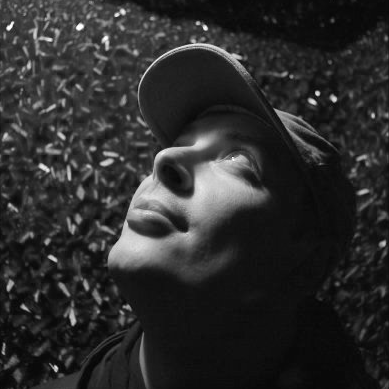
Robert M. Thomas is a pioneering composer, sound designer and audio programmer.
He not only creates innovative music but redefines the way music itself is experienced. Unlike fixed recordings or streams his music can intelligently adapt & personalize itself in real time through the bespoke software he creates. Through experimental instrumentation, elaborate production techniques and creating bespoke software / technology he often creates breakthrough experiences.
His work has been performed at the Barbican London, Walt Disney Concert Hall LA, Lincoln Centre NYC, NXT Museum, 180 Strand, COP26 Glasgow, Somerset House and exhibited at the Tate. His many collaborators include ambient pioneer Brian Eno, trip-hop innovators Massive Attack, film composer Hans Zimmer, singer-songwriter Imogen Heap, sound designer Ben Burtt, neural artist Sofia Crespo and the trailblazing London Contemporary Orchestra.
His commissions include Los Angeles Philharmonic, The Barbican, Tate St Ives, BBC, Sky, National Geographic, Google, Bose, London Design Biennale, COP26, and Boiler Room.
Robert is a leading expert in adaptive and generative functional music for health. He has composed many functional music soundtracks including music for exercise, driving, meditation, sleep, emotions, focus, lunar cycles, traffic, weather, heart rate, internet data, stress levels and had entire audiences interacting with his music.
Full Biography
by Marc Weidenbaum
As a composer, performer, coder, designer, and thinker, Robert M. Thomas has pushed music and sound forward over the past decades like few other artists of his generation and is a rare example of a true musical pioneer. Thomas is an innovative British musician who explores how experimental instrumentation, bespoke technology, and elaborate production techniques can yield new forms of expressiveness and experience. He regularly creates breakthrough concepts and modes of interaction for his audience and collaborators alike. His work has been performed at Barbican London, Walt Disney Concert Hall LA, Lincoln Centre NYC, COP26 Glasgow, Somerset House and exhibited at the Tate. His commissions and clients include Los Angeles Philharmonic, BBC, Sky, National Geographic, Google, Bose, London Design Biennale, COP26, The Tate and Boiler Room and his collaborators include ambient pioneer Brian Eno, trip-hop innovators Massive Attack, film composer Hans Zimmer, singer-songwriter Imogen Heap, sound designer Ben Burtt, and the trail blazing London Contemporary Orchestra. He has also composed many pioneering functional adaptive music soundtracks including music for exercise, driving, meditation, sleep, emotions, work / focus, lunar cycles, traffic, weather, heart rate, internet data, and stress levels.
Thomas’ recent collaboration with Eno, along with visual artist Es Devlin, exemplifies the breadth of his creativity. Their Global Goals Pavillion was an installation at Somerset House as a main part of London Design Biennale 21. The trio transformed the courtyard into a sudden urban forest that served as a model of sustainable artist activism. Thomas composed the sites immersive participatory musical experience, one in which audio messages recorded by visitors were processed, in real time, becoming part of an ever-changing generative music installation. The project attracted Thomas due to its emphasis on democratic principles, social participation, global citizen responsibility, and environmentalism.
Those same themes play out in several other recent works, notably Stitched and the Eternal Golden Braid. In 2019, Stitched was created as a commission for the unveiling at Bridgepoint Rye of the Hastings Tapestry, a sprawling visual depiction of 900 years of British history. Thomas’ piece was performed at the opening of the exhibit. As the audience moved around the hall and near events in history, the music altered and changed in response. Thomas played as part of a chamber ensemble selected from the London Contemporary Orchestra, featuring unusual historical instruments like viola da gamba and sackbut as well as alto flute and violin. Thomas also composed a soundtrack for the overall installation that played throughout its summer-long installation. The 27 panels of the tapestry were handsewn in 1966 by Royal Society Embroiderers to commemorate the 900th anniversary battle of Hastings. The display of the work was innovatively refreshed by stage director and filmmaker Tim Hopkins. (Thomas and Hopkins had worked together previously on Empathy Machine, a virtual reality that employed opera as a means to find common ground between individuals with opposing viewpoints.) Thomas recognized in the original Hastings Tapestry a rather sanitised view of British history. The reworking, coincident with the heat of Brexit culture wars, offered a reassessment of British identity. To that end, Thomas quoted abstracted bits of nationalistic themes, including “Jupiter,” from Gustav Holst’s The Planets, as well as both “Nimrod” and “Pomp and Circumstance” by Edward Elgar.
The Eternal Golden Braid is an adaptive composition performed at the Barbican in March 2019. An audience of 2,000 people influenced the composition while it was being played by holding up red and blue card symbols. In a pre-recorded interview with Douglas Hofstadter, whose classic book Gödel, Escher, Bach inspired this event (the piece’s title is the book’s subtitle), Marcus Du Sautoy posits Bach as a musical coder, one who applied rules to musical material with the intent of growing something complex and beautiful. Bach’s works were fed through a machine learning process, created by computational artist Parag K. Mital, which then “composed” a piece of its own based on the resulting data. Thomas adapted and developed some of the AI output into a work that, in turn, reacted to the audience. The Eternal Golden Braid was performed by a string trio consisting of London Contemporary Orchestra soloists. Thomas used the opportunity to explore the more experimental realm of neo-classical music, one in which extended techniques applied to standard instrumentation led to a wholesale reimagining of the standard repertoire, akin to the work of Jóhann Jóhannsson and Hildur Guðnadóttir. Thomas intended The Eternal Golden Braid as an examination of group consciousness, using strange loops of perception within music as a metaphor for political participation in the era of Brexit.
The Creative Technologist
It was a desire to do more with music that took Thomas down the path from playing music to playing music with code. His ambitions for the experiences he wanted to create couldn’t be facilitated by existing off the shelf software, so eventually he built his own software library called Fluid.
Throughout his life, Thomas had always felt that music is, at its core, fluid and constantly changing. That is music’s nature. Even composed music is a starting point, not an end. Live music, especially improvisation, retains the possibility to do this, but throughout the past century he feels we have more and more come to define music within the constraints of the fixed final form of the studio mixdown. In this sense, there is little meaningful difference between the wax cylinder, vinyl record, tape, CD, MP3, and digital stream. They are all music frozen in time: start, middle, end; never changing, never personalised, never responding to external variables.
While Thomas’ musical output, both solo and in collaboration, embraces the worlds of top level musical performance, elaborate studio production, and expert recording, his software skills allow him to go beyond the fixed document. His work engages deeply with the possibilities of adaptive and generative music, of music that changes based on audience input, and can grow on its own.
Much of his recent work involves sounds that react to unusual stimuli. A key example is the official app for the Christopher Nolan film Inception, which was developed in collaboration with Hans Zimmer by innovative app company RjDj, while Thomas was Chief Creative Officer there. The app was downloaded more than 6.5 million times worldwide, and was the No. 1 app in the App store in many countries. The app integrated the listener’s experience into their surroundings, including such variables as the phase of the moon, the pace at which you’re moving, and even which continent you’re on.
For an interactive app with the trip-hop band Massive Attack, he created custom algorithmic remixes on the anniversary of their classic Mezzanine album. The app allowed users to navigate custom remixes of each Mezzanine song based on their phone’s sensors: adapting in realtime to a moving image, as well as movement, touch, and face expression recognition. It also tracks all playback of the core musical stem material in the blockchain.
These popular apps that Thomas has developed are a step toward functional uses, notably health applications. A highlight of this activity for Thomas is his work in generative music for Wavepaths, in collaboration with musicians Jon Hopkins, Abul Mogard, Andrea Belfi, Robert Rich, Greg Haines, East Forest, Slow Meadow, Superposition and Galya Bisengalieva among others. Thomas has extensively explored music that responds to how you’re breathing, changing how you experience your heart rate, even rewarding you if you’re successful in reducing stress. Biofeedback music is highly personalized, opening up the opportunity to create a soundtrack for bittersweet emotions, or tense emotions, or any along the continuum, in a seamless, intuitive way.
Thomas brought to his digital experience work his initial training as an Architect, which taught him to imagine myriad ways a given space might be explored, how to structure experiences while leaving opportunity for individual choices. That pragmatic art school experience gave him a philosophical foundation that serves him to this day.
The Startup Veteran
Thomas has become a sought-after digital innovator and consultant to create generative experiences for startups in a variety of realms, including film, music, games, and biotech. He brings to the work not just his musical and programming skills, but the full gamut of someone who has served as a Chief Creative Officer, as he did at RjDj, the groundbreaking app foundry. He applies deep knowledge in UX design, how to bring products to market, how to derive intelligence from analytics, how to harness virality, and the underlying business of app ecosystems.
This is true for his solo work, as well. He’ll soon be launching his own musical project, which Thomas thinks of as the answer to a timely question: What if an album were a start-up? That is, what if one’s release had the scope and scale of a truly modern digital product line, complete with MVP debut, user accounts, agile feedback cycles, and iterative improvements over time. Tetricus is a deliberate attempt to bypass what remains, even in the age of Spotify-dominated streaming, still the standard route to doing music.
The Musician
Of course, none of these activities would be as meaningful had Thomas not, himself, paid his dues as a conventional musician first. He started out, long before coding projects for Disney Hall, or collaborating with Brian Eno, or working on augmented reality apps, or studying architecture, as a trained musician. Back at the dawn of the new millennia, singer Sarah-Jane Taylor and him were spotted for a development deal with the Transistor Project set up by accomplished manager Jim Beach (Queen) and Dave Rountree (Blur) . After that experience, he moved on to video games, which led to RjDj, which cascaded to where he finds himself now: at the forefront of music as a truly digital-analog hybrid, freed from the constraints of recording, and adapting as the future comes into focus.